Wednesday, October 7, 2009

Vegan MoFo Day 7: Preparing for Greens


My mother emailed me today to let me know that her fall crop of turnip greens is starting to come in. As I started to think about turnip greens, I suddenly realized: I am almost out of pepper vinegar! I can enjoy greens without pepper vinegar, but it sure is nice to have.

Despite being a tired mofo tonight, I pulled open the vegetable drawer, and found a respectable number of hot peppers of various kinds. I had to break some of the long ones in half to fit them into a quart jar. (This will increase the heat of the final product, but that is OK by me.) I then covered with apple cider vinegar, capped, and stuck it in the back of the fridge. My grandmother always kept her pepper vinegar in a big cruet on a shelf, so I don't think you need to refrigerate. It would be best to wait for a couple of weeks, but I will probably break into it sooner.

Tuesday, October 6, 2009

Vegan MoFo Day 6: Jo Stepaniak Appreciation


It's been a long, busy Monday, and the weather is murky, cool, and wet. I want something warm and comforting for dinner, so I reached for Jo Stepaniak's Vegan Vittles. Her Creamy Potato Kale Soup is easy, fast, and an all-time household favorite. You can see it in its very early stages above. It is bubbling in the background as I type.

My earliest attempts at a plant-based diet took place in an ancient era that is almost lost to memory (the late 80s to early 90s), so authors like Jo Stepaniak and Louise Hagler will always have a special place on my cookbook shelf. I mean, Jo is the woman who brought us a whole cookbook about making tasty "uncheese" (Crock Cheez, anyone?) at a time in history when commercial vegan cheese was uniformly awful. And she is still churning out excellent work today!

In other news, while cutting through the Ellington Agricultural Center tonight, I noticed the signs are up for this year's Music and Molasses Festival, coming up on October 17-18. Unfortunately, a lot of the food is very non-vegan, but the entertainment is good, and it is a great opportunity to stock up on my favorite local sweetener, sorghum molasses.

Monday, October 5, 2009

Vegan MoFo Day 5: Simple sourdough


I like complicated bread recipes as much as any other crazy baker, but life gets busy and I don't always have time to plan, purchase unusual ingredients, etc. My fall back approach to our weekly bread baking is the following simple approach to sourdough.


1. I made my own starter a couple of years ago, following the directions in Peter Reinhart's Whole Grain Breads. His "pineapple juice solution" really helps avoid common problems in getting a starter underway. I think the directions will appear also in Reinhart's new book, Artisan Breads Every Day, which is due to hit stores later this month. Once a week (or at least once every two weeks), I pull out about 2-3 oz of starter (a big spoonful), and mix it with approximately 2 c flour and 1 c water. You can see the consistency in the photo above - just a little wetter than final bread dough. Depending on how much flour I scooped up, I will have between 12-16 oz of starter. I put it in a bowl with a loosened lid on the kitchen counter for 4-6 hours and then punch down, cover tightly, and refrigerate. During the week, I may open the lid a couple of times to give it some air.


2. I then take the rest of the previous week's starter (10-12 oz, more or less), and mix it with flour, salt, and water, according to how many loaves I want. For two sandwich loaves, I put about 5-6 cups of white or wheat flour, 1-2 cups other flours (chickpea, rice, fava, coconut, oat, etc), 2 t kosher salt, and other stuff if I feel like it (e.g., a handful of nutritional yeast). Then, I start with 2 c water, and begin kneading, adjusting with flour or water as necessary to get a soft, supple, slightly sticky ball of dough. Put the dough in a greased bowl, cover, and let it rise on the counter for at least 6 hours. The long rise is necessary due to the lack of commercial yeast, and contributes to a strong sourdough flavor. I work half-days on Fridays, so I set the dough to rise before I leave and continue when I get home.


Punch down the risen dough, put into greased loaf pans and let rise for 90 minutes to 2 hours, or whenever it looks ready to go. Bake at 350 F for about 50-55 minutes. I usually leave one loaf out for us, and freeze the other one, so it stays fresh for later in the week. It's good bread, and simple.


Note: Both of the Reinhart books above are vegan-friendly. There are certainly some non-vegan recipes, but many vegan ones and many others that are easily veganizable. I tested for Artisan Breads Every Day and made almost all the recipes. I was very happy to find that his challah recipe veganized with ease. The rye bread is the best I've ever had outside of a NYC Jewish deli (and it could give some delis a run for their money). The wild rice and onion bread is delightful and perfect for autumn. If you enjoy baking, don't miss it!

Sunday, October 4, 2009

Vegan MoFo Day 4: More Gadgetry!


Behold the mighty bean frencher! I love french-cut green beans, but I am not a fan of the slow and annoying process of slicing them by hand. A bean frencher makes short work of this task - and it is a small and inexpensive item. I'm not sure it can do anything other than cut green beans, but if you have discovered multitasking potential in this gadget, let me know.


I usually steam the beans, and serve them with toasted slivered almonds, and you cannot go wrong with that approach. However, a friend recently introduced me to a Dutch recipe called blote billetjes in het gras (naked bottoms in the grass). It's very simple and pleasing in a comfort food way: Boil the french cut green beans with an equal weight of chopped potatoes. Drain and mash with a little nondairy milk and vegan margarine. Add salt and nutmeg to taste, and stir in some cooked white beans (these are the bottoms). For 8 oz of green beans and 8 oz of potatoes, a 15 oz can of white beans (drained and rinsed) is about right. Easy!

Saturday, October 3, 2009

Vegan MoFo Day 3: Tool Time!

Kitchen tools can add a lot to the fun of cooking. I'm not a big fan of tools that do things I can do just fine without them - rice cookers, bread makers, and such. (However, if these items will get you into the kitchen, don't let me stop you.) But I will shell out cash for fun toys like a spiralizer... a miraculous item (mostly from Japan, it seems) that will turn any reasonably solid vegetables into ribbons or noodles or other shapes. The one I have is called the "Benriner Cook Help," but there are a number of brands. The Benriner is easy to use and to clean.


Today I ran a small butternut squash through it with the most narrow blade. I then mixed it with some arugula (rocket to some of you...), about a teaspoon of olive oil, a half a teaspoon of umeboshi plum vinegar, and a few good shakes of Arizona Jalapeno Salt (from the amazing and talented Kim). A light and yet autumnal lunch, prepared in less than 10 minutes. And pretty much raw, too!


I'm glad the weekend is here so I can catch up on MoFo reading and commenting!

Friday, October 2, 2009

Vegan MoFo Day 2: Recent Acquisitions


Anyone who knows me knows that I have, well, a few cookbooks... and I love them all! I have recently acquired two particularly good ones that are definitely worth sharing with you. The photos are acting up on me (sizing, turning) but it's just going to have to be that way!


First, having long been a fan of Dynise Balcavage's blog, I was thrilled when her cookbook, The Urban Vegan, appeared. With her creativity and encouraging voice, both new and experienced cooks will find much to adore here. So far, we've made two recipes. While holed up with the flu, I nursed myself back to health with her Hearty Adzuki Bean Soup. It looks similar to a pureed black bean soup, but when you put it in your mouth - woah. Mushrooms, seaweed, sesame, general flavor explosions... Two nights ago, we made the Spaghetti alle Melanzane (Spaghetti with Eggplant) for supper. This definitely ranks right up there with my favorite eggplant dishes of all time, which says a lot. It's a superb pasta sauce that only improves with time, so the next day's lunch will be a special one. I added a little thyme and black pepper to her recipe, but she encourages such branching-out!


After a couple of dry years, we have had a lot of rain in 2009, and excess vegetables. Thus, I have become a canning, freezing, drying, pickling machine. I have a number of home preserving books, but the new edition of Linda Ziedrich's The Joy of Pickling truly belongs on the top of the pile. Her general guidance and directions are clear and easy, while her recipes are imaginative and delicious. You will see her pickled cantaloupe above. I have had a lifelong love affair with pickled peaches, and pickled cantaloupe is a close relative. I've also made her pickled watermelon rind and full sour dill pickles, both of which were excellent. There are a few nonvegan recipes, but they form only a small portion of the book. Ziedrich's book on jams and jellies is equally helpful, so pick up a copy of that one, too!
More recipes and food experiments coming soon....


Thursday, October 1, 2009

Vegan MoFo Day 1: Time for Tinctures


The Vegan Month of Food (Vegan MoFo) is back! As is this blog. I seem to be able to post about food regularly on Facebook, but I have been very negligent in transferring such posts to this blog or the PPK. Vegan MoFo is here to rescue me!


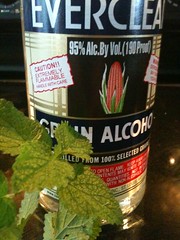
We are finally seeing some cooler weather in Tennessee, which brings to mind the inevitable upcoming frosts, a few weeks down the pike. Our herb garden is overgrown, and I am committed to salvaging as much of it as possible before it dies off for the winter. One easy and fun way to do so is to make herbal tinctures. You can simply throw fresh herbs into Everclear or vodka, cap the jar, stick it in a cabinet, and wait. However, this year, I am following a more complicated process.


I picked a LOT of lemon balm, and dryed it in my dehydrator at 95 F. I then ground it fine. A food processor or coffee grinder will do the job, unless you feel like an old alchemist and want to use a mortar and pestle. Dehydrating first lets you get a large amount of herbal matter into a smaller amount of alcohol, with a more intense result. I put the ground lemon balm in a jar and added 1/4 c Everclear for each ounce of dried herb. (I am not 100% sure that Everclear is made through a strictly vegan process, and was unable to confirm online. However, most hard liquor is vegan.) I placed a piece of plastic wrap over the top of the jar (to prevent contact with metal), and screwed on the lid. I then wrapped the jar in foil to keep it dark. It lives on the counter and I give it a shake once or twice a day.


After about 3 weeks, I will strain the tincture (using a coffee filter) and put it away for use. It will keep indefinitely. A few drops will great flavor to sorbet or mixed drinks. A single drop brings mystery to a salad dressing. This weekend, I hope to start more tinctures - maybe lavender and basil.